Showing posts with label mental break. Show all posts

Friday, August 24, 2018

Old Friends, New Friends


We are welcoming back old friends and new at the beginning of the Fall Session.  :)  For this Small Group activity we worked on hearing beginning sounds of friends' names, and matching up the correct letter link.  Ms. Harmony printed the names and letter links separately, and reused this idea later as a Planning tool.  This activity was a great way to practice reading and saying our friends' names and developing phonemic awareness.


Another way we talked about friendship this week was through finger painting and storytelling.  Here, Ms. Harmony presented the idea by talking about "Red Friend" who liked to play alone.  She had a great ideas and really liked working on her own plans.  Another friend at school, "Blue Friend," also liked to play alone.  That's why we have an Alone Table.  Sometimes that's a great place to choose.  But one day, Red Friend and Blue Friend started working together.  They SHARED their ideas by working on the same plan at the same time!  When they worked together, they got something new!  "Purple ideas!"  When we work with other friends, we also get to play in new ways and hear new ideas.  Sharing a plan is fun!


Then the school friends were given their own opportunity to tell a story about Blue Friend and Red Friend.  We talked about whether the friends were playing alone, next to each other, or if they were playing WITH each other.  


(Friend "K" prefers not to put her fingers in the paint.  She solved her problem by getting paintbrushes from the art easel so that she could still participate in the activity.  Good thinking "K!")

Then when friends moved into Work Time, we could use the same language that we had just practiced in Small Group.  When we work together on the same plan at the same time it's called "sharing."


We can also choose to work alone and that's a great way to hear and practice doing our own ideas!  Friend "S" was celebrating her birthday and used the monkey peg board to make a birthday cake!  Happy Birthday, Friend "S."  You are going to have a great time being FOUR!  Wow!  :-O


Tuesday, August 21, 2018

Supporting the Play


You know you are in the right job, when you finish up your day feeling energized!  Helping the school friends work on their plans, work together, develop language, solve problems, and feel satisfied with their work is the best thing ever.  Here are some of the plans that the school friends have worked on recently:


Blocks, blankets, and Littlest Pet Shop animals!  The children used lots of language about shapes, naming animals, sorting into pets into animal families,  explaining how to wrap up animals to make beds, and where to place what in the building.

Working Alone:  The school friends have all learned to respect the Alone Table as somewhere safe and fun to go to when they want a break from everyone else.  Here Friend "K" finds the correct shape buttons to complete the picture, counts the buttons, and finds the corresponding number.  She has risen to the challenge of finding and distinguishing pentagons, hexagons, and octagons to fill in the giraffe picture.


Recreating Real Life:  Friend "B" and Friend "S" have often worked together to go grocery shopping or make a doctor's office for babies and pet dogs.  They load up purses and bags with "food" or "medical supplies" to take the best care of their patients.  They demonstrate kindness and empathy as they bring aspects from their lives into the playroom.


Friend "K" traveled by plane to visit far-away family this summer.  This is the part of her life that she has recently brought to play.  She sets up the Little People homes far away from one another, loads her people onto the plane, includes a "driver for the airplane," and takes the family to visit.  Once the plane lands, they get a "new car" to drive while they are visiting.


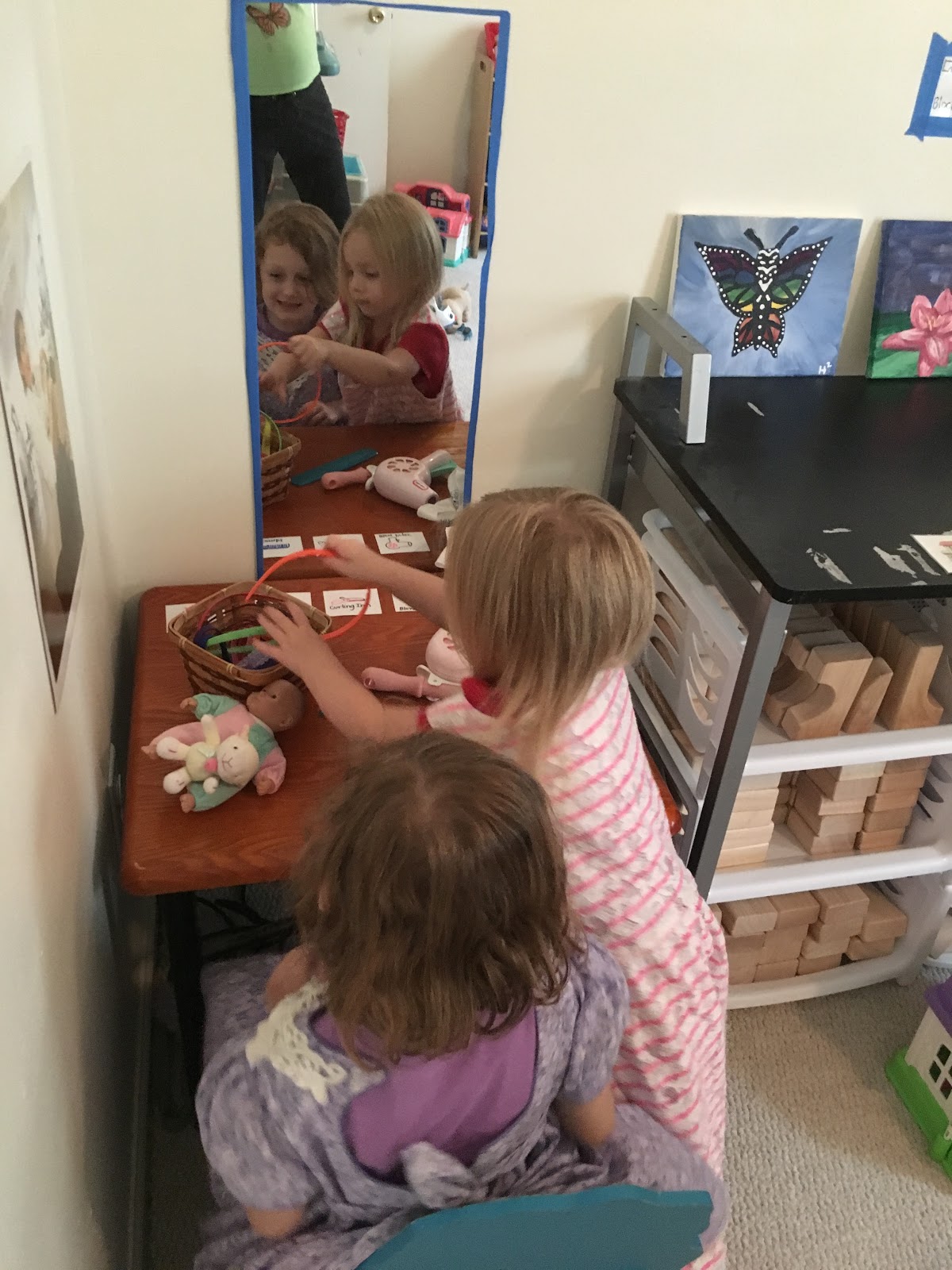
Playing Pretend:  Today, Friend "K" invited her school friends to dress up and go to the hair salon.  We each took turns wearing the styling cape and having our hair combed and styled.  We were FANCY.  ;)


Friend "B" did most of the work as the stylist.  She knows about doing hair!  ;)


Tuesday, March 20, 2018

Be a problem solver!


This is what we want our preschoolers to be: a problem solver!  Often, when crisis erupts in the classroom, teachers ask questions like, "How can we solve the problem?"  "What are your ideas?"  "Would you like help solving that problem?"

When the child is able to delay gratification, consider another's perspective, formulate a solution that is fair and safe... then they are developing both social-emotional and critical thinking skills, not to mention the language skills to explain a problem and idea to solve it.  With time and practice, the child will need to rely less on the adult and more on self to problem solve socially with peers.

But... helping young children problem solve doesn't always go as smoothly as the book or poster seems to imply.  After two years of calmly approaching children, helping them negotiate, work through problems, sometimes it just. didn't. work.

I felt like it was because the child might be so upset that they couldn't focus on my words, rise above the intense feelings they were experiencing, to think at a higher level and solve a problem.  I was in the trenches with the kids everyday, and I wanted them to be able to self-regulate and talk through problems with their friends.  What to do?  I created the Problem Solving Basket... and it literally transformed the classroom!  I've used it every year since then.

I introduce the Problem Solving Basket to my class during Large Group times often in the beginning of the year.  Teachers will role play with each other, and then include children, to practice problem-solving.  Usually when children fight over a toy, there are three ways to solve a problem: share (both use it at the same time), trade toys, or take turns with a timer (the child who had it first gets to finish his/her turn).  We demonstrate what each card looks like and sounds like,

  • "Let's do this idea!  We can share and both use it together!"  
  • "I'm not done.  You can have it next."  
  • "Can I have the red car?  You can have this blue one that I have."


Why does the basket work?

  1. The children literally have to step away from the problem to go get the basket.  This gives a few seconds to calm down.
  2. The children can focus visually on the symbols of the cards (stick figure pictures) and on an adult's voice, so understanding the solutions is enhanced.
  3. It feels like a game: which card do we choose?
  4. Even young children who cannot fully explain their ideas can point to the card that they want to use in problem solving, and an adult can scaffold the language gap.
**Sometimes the basket has even had hand puppets, or dice.  You can create the basket to suit your children's needs.  If a child is upset, communicating with a puppet sometimes helps bridge the gap between feeling and thinking and words.  Older children might like the enhanced feature of rolling the dice: the person who gets the biggest number gets it.  Do what you want that works!**

We have created Problem Solving cards for apologizing, using an indoor voice, or using manners (saying please).  We've used an "Ignore" card to help children remember to focus on the teacher instead of a child who is looking for attention with disruptive behaviors.  

Basically, there is beauty in the simplicity, flexibility, and efficiency of the basket!  The children learn to solve problems and learn the social dialogue of problem solving much more quickly when using this tool, than when they didn't.  Soon, they don't need the basket to prompt them; they problem-solve on their own!  :) 

Thursday, March 1, 2018

Is the Alone Table a Place for Timeout?


The Alone Table during February was set up to be an X-ray machine at the doctor's office.  The children could select different x-rays to see bones from the human body, work a Sesame Street puzzle, and explore different systems of the body in the DK Human Body book.

What is the function of the Alone Table?  Isn't preschool about socialization?  Basically, is it just a "time-out" spot?

Well, if you consider "time-out" to be a punishment, then no, the Alone Table is not a "time-out" place.  But it can be a calm-down center for one person at a time.
  • Self-discovery-  Sometimes children need to work alone so they can develop that inner voice, hear their own thoughts, and work out their own ideas.
  • Mental break-  Sometimes children need a break from playing with peers, which is a mentally and emotionally strenuous activity for children learning to practice social rules and emotional regulation.
  • Social problem solving-  Sometimes when social problems occur over materials in the classroom, the children are too upset in the moment to think about whether they want to share, trade, or take turns.  They need to take a break at the Alone Table, and after calming down, realize that they DO want to solve problems with friends, and so are then able to reach a resolution and re-join their peers.
  • Communication-  When a child moves to the Alone Table, s/he communicates to his/her peers that s/he wants to work alone.  S/he communicates that s/he needs space for a few minutes.
  • Behavior regulation-  Sometimes when a child experiences sensory overload, is learning appropriate behavior for the first time, and/or has developmental "growing pains," the child behaves in a way that is inappropriate or unsafe.  Under these circumstances, the child is invited to work at the Alone Table until the child is able to respond to teacher redirection and appropriate behavior is restored.
The Alone Table is way more useful, and beneficial, than a simple "time-out" place.  I frequently update the materials at the Alone Table to allow children to experience all the benefits from learning to work alone.


What's with the "Names?"

For new readers of the blog, this post is an explanation of the "names" Ms. Harmony uses when she writes about the school happe...

Read More!