Showing posts with label phonemic awareness. Show all posts

Wednesday, June 23, 2021

10 Embedded Pre-Literacy Activities... Here's some ways we've been doing it!


1. Play with SOUND! So much of decoding words in the future starts with careful listening in early childhood.


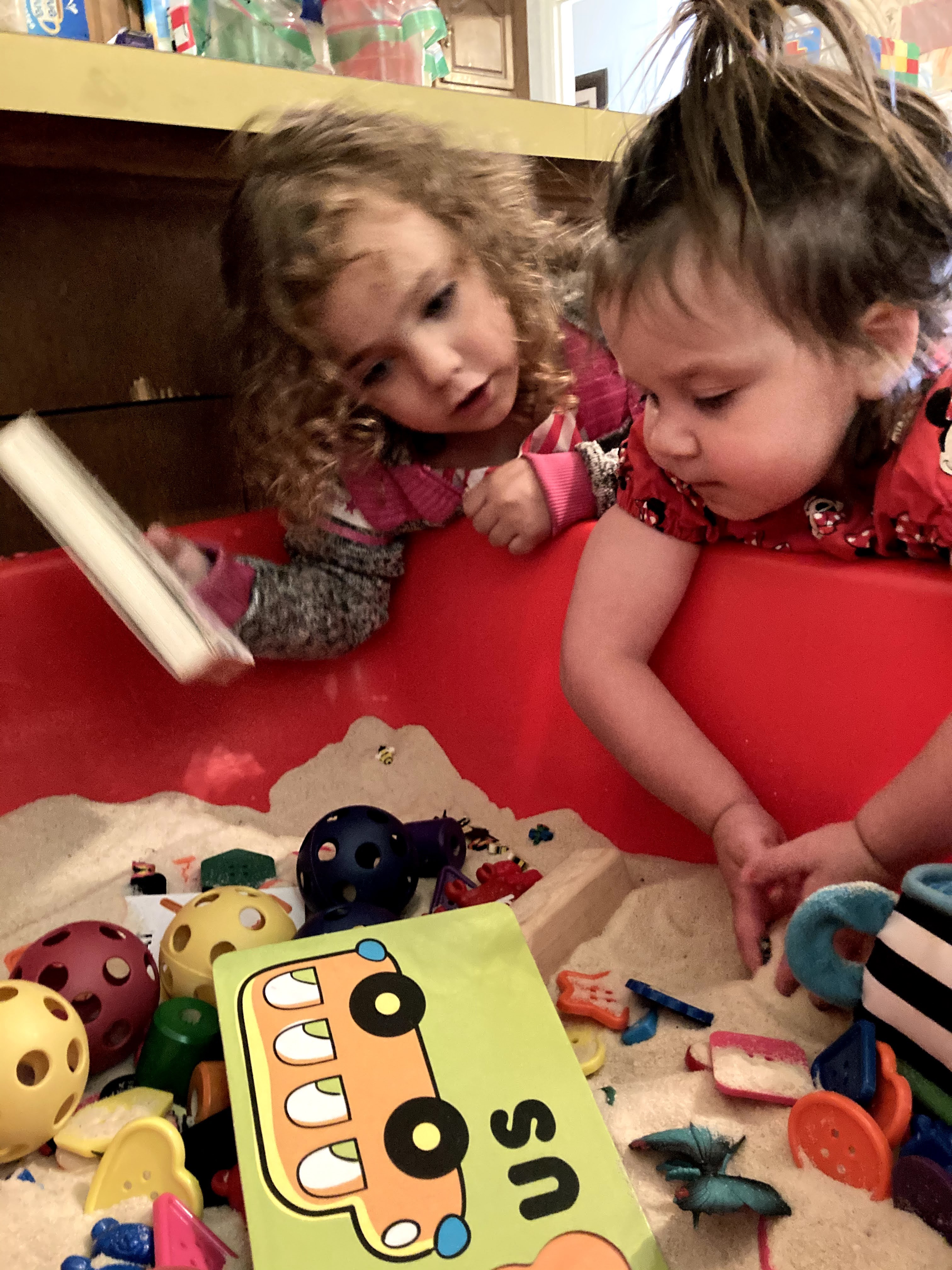
2.  SOUND Explore Tables: this table had all things beginning with the /b/ sound. Simply naming the objects in the Explore Table produces natural opportunities to HEAR alliteration.  Some of the things in this set up included "beach sand," books, bears, bugs, butterflies, balls, buttons, large beads, flashcards with B words and letter, and blocks.


In addition to objects beginning with the /b/ sound, hidden magnet B letters and wooden letter B's were in the "beach" to be found and touched as well.  Finally, as we played, we made stories with the toys, like: "The blue bears sit on buttons around the bead table. They are having bumblebee soup!" or "Bugs are riding on the bus all the way to the beach!"

3.  Chatting with friends! It's true that this is a pre-literacy skill because conversation with peers and adults help children's vocabulary grow which is required for reading comprehension in the future.


Role play isn't a waste of time!  It's a natural opportunity to talk, assume the role/feelings/behaviors of another person or animal, and develop cognitive and language skills.

4.  Rhyming pups: we love playing with puppies and kitties! These toys made by Learning Resources allow us to make mis-matched rhyming pups which are terribly silly!  When we fix the pups, we HEAR two words that rhyme correctly.  (See how much hearing factors into literacy?)

5. Letter names, recognition, and shapes: Letters are symbols for SOUNDS, and as children develop, they memorize the names and sounds of each letter.  Pre-literacy includes being able to see different kinds of lines that make up letters. Some letters have "holes." Some letters are completely curvy.  Other letters are made up of straight lines that go in different directions. This peg toy by Coogam helps children look at what kinds of lines make up a letter, and focus their attention on which direction those lines are going.

6.  Read a book, and act it out! Caps for Sale became a huge hit for our kids last week, and we used our rug cushions to pretend to be cap peddlers.  Acting out a story demonstrates the ability to recall the order of events in a story, and understand the plot of the story. Both skills are critical for reading comprehension.


7. Read for fun! During Work Time, the children often choose to look at books or invite the teacher to read them individually.  Young children can identify the difference between pictures and texts, tell their own version of the story based on pictures, and ask for help to know "what do these words say?". 


8. Gross motor development: This seems to be an unusual skill set to include with pre-literacy development, but they are connected. The brain learns to integrate information from multiple senses (visual, tactile, vestibular, proprioceptive, and even auditory) through gross motor opportunities. As the senses become more integrated, the child develops the ability to focus their eyes on targeted words on a page, track words across a page, and even keep letters oriented and in the correct order while reading.  Without well developed coordination and balance, decoding and tracking words becomes SO laborious for the reader, that reading comprehension becomes nearly impossible.

So climb, and dance, and run, and crouch, and jump as much as possible.


9. Scanning: this Melissa and Doug toy is intriguing to young children because they enjoy the cause and effect of dropping in the spool and see it spin down the ramp, but this also helps the children develop the ability to track an object moving left to right and back again.

10.  Drawing: The children have free access to the Art Area during Work Time and are provided multiple choices for mark making (paint, markers, crayons, pencils). The advantage of free form mark making is that it engages more areas of the brain than tracing does. Here is a sample piece of art done by one of our two-year olds that demonstrates she is developing the ability to draw curves, straight lines, circles, and dots.  These are all lines she will later learn to associate with letter shapes, and are a precursor to writing.  Furthermore, she is learning that marks have meaning.


It seems like "just play," but each of these distinct (yet related) methods of developing pre-literacy skills are fundamental for children to experience prior to formal academic education.  How can you bring more of these ideas into your home and environment? :)

Sunday, December 13, 2020

Christmas is Coming!


And we've been preparing to celebrate this holiday!  These are some of the ways we are getting ready for Christmas.  We like to use these village blocks and magnetic Christmas tree to create a complete Christmas village.  


We've engaged our senses with a variety of textured ornaments, Christmas ducks, finger puppets, chimney tubes, sparkly trees and gingerbread boys, and even cinnamon pinecones.  One of the most enjoyable results from this provocation is hearing the children invent stories about Santa going down the chimneys, snowball fights, gingerbread boys outrunning reindeer, and more.  Additionally, the children engaged their fine motor skills by threading fuzzy sticks through the ornaments and hung them on the Christmas tree.


We've worked with green and white paint at the art easel, determining what happens when these colors are mixed.  

One of the BEST part of the Christmas season is driving after dark and seeing the lights!  Night time field trips for preschoolers are impractical, so we turned off the lights and turned on our glow sticks to play with lights.


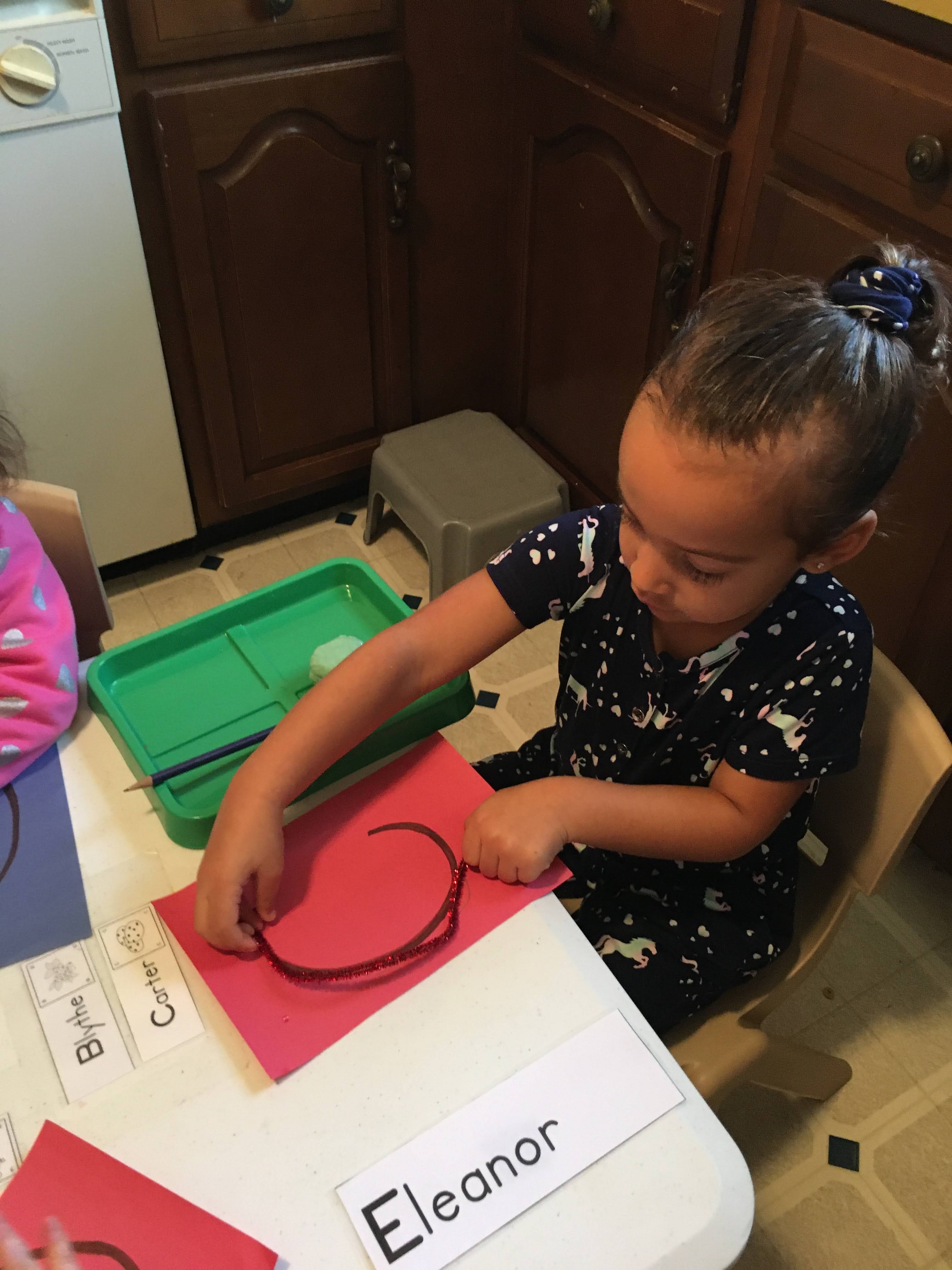
Some of our friends have become more interested in letters.  Ms. Harmony planned a Small Group activity where each child was given a large letter 'C' for Christmas with a pencil, a fuzzy stick, and a ball of play dough.  One friend in particular, loves the letter 'C' because it is the letter the starts her name!


The children were encouraged to trace the letter with their fingers or pencil.  We talked about how the letter 'C' has a curvy shape.  We tried to form this shape with the fuzzy sticks and/or play dough.


Some of our friends were even able to hear the /c/ sound that 'C' makes and thought of their own 'C' words: candy cane, Christmas tree, carols, and cookies!

Christmas is coming, and we are almost ready!  Songs, lights, smells, letters, and stories... so many ways to fully experience the joyous holiday.

Tuesday, June 30, 2020

School is Back with Some New Friends!


We kicked off our summer session last week, and it has been so exciting to have new friends to play with!  We played the "Friends and Neighbors" game where we examined different scenarios of friends in need, and decided how to help them.  This game was helpful in guiding our conversation to different emotions, and why the character felt sad, or frustrated, or hurt.


We played another game where we matched our friends' names with their letter links.  This helped us practice saying our friends' names, but also helped us to listen to the way the names sound... especially the beginning sound of the name.


But most of all, we practiced BEING a friend by playing with friends!  This is our 'S' for Summer explore table!  (Everything in here starts with the 's' sound: sand, sea shells, suns, stars, sandals, sun glasses, stamps, and spoons.)


Friend "Alarm Clock" collected all of the sun rings.  She showed her friends how to put them on her fingers, and helped her friends do the same.  It was pretty tricky for some of our younger friends to slip those suns on each finger without dropping any!


But it was also cool to have a handful of sunshine too!  One of the best things about playing with friends is that they introduce new ideas and new ways to play.  :)

Friday, August 9, 2019

Bippidy Boppidy Boo


Friend "Kangaroo" has been begging all summer to make a new "magic wand" because her old one broke.  During the last week of school... we did it!  First we painted bubble wrap, stamped our papers on it, and added glitter.  When we came back to the project later in the day, the school friends decided what shape they wanted their wands to be.  We taped a dowel rod inside and wallah, a new magically fantastical wand!

Next we used these in Circle Time where we read one version of the Cinderella story.  The fairy godmother is depicted as having a wand with a star.  When we got to the point in the story where the fairy godmother uses her wand to transform pumpkins into coaches, mice into horses, a toad into a driver, etc. the children helped too by completing the rhyme!

For example, Ms. Harmony would say: "Bippidy boppidy boach, I turn this pumpkin into a ...." and the children would respond "Coach!"  We all waved our wands while working our magic.  ;)  Soon we helped Cinderella get to the ball, return home safely, try on shoes, and marry a prince.

This art/literacy combo activity was definitely a "happily-ever-after" choice for this group!


Wednesday, July 17, 2019

Preschoolers as Scientists


"Let's do what scientists do!  We'll study something, look at it up close, touch it, smell it, listen to it, and think... then write down what we've learned.  We can record our ideas with words, pictures, or tracing."

This was our Small Group prompt on Tuesday.  The children were each given a clipboard, pencil and sheet of paper.  They could choose a magnifying glass, and from a variety of star fish, sea shells, and shark teeth from the basket.


Some things we learned during this activity is that only the swirly shells sound like the ocean.  Flatter shells, starfish, and shark teeth do not.


We used a lot of descriptive language like: smooth, spiky, rough, tooth-like, sharp, spiral, striped, and so much more.  The students were encouraged to write or draw these words.


We even learned where the starfish mouth was!  Imagine eating from your belly button!  Starfish have a mouth right in the center of their bodies.  Tracing the starfish was challenging as well.  All of the starfish that we used had five legs.


 Here are some samples of the notes the children made.

Toddler "K" (age 2) "traced" her star fish by drawing circles around it.  She made some squiggles which she indicated were the words "starfish."  Ms. Harmony helped her write out the letters so another adult could read her words.


Friend "K" (age 5) traced her starfish and shark tooth independently.  She also drew her representations of seashells and labeled her diagrams.  She sounded out the words she wanted to write and wrote the letters herself.  If she was uncertain about a sound, Ms. Harmony would help her identify the correct letters like, /sh/ and /oo/.


Friday, March 29, 2019

What's with the "Names?"


For new readers of the blog, this post is an explanation of the "names" Ms. Harmony uses when she writes about the school happenings.

The school friends, and even Ms. Harmony, have a symbol called a "letter link" that corresponds to each person.  Simply, a letter link (from High Scope curriculum) matches both the letter and phonemic sound of the first letter in the child's name.  Having a letter link and using them frequently when we talk to our friends at school provide the students many many opportunities to hear matching beginning sounds in words, which is an important pre-literacy skill to have.  It also provides them opportunities to see a bolded letter with a symbol, which helps the children learn to read each other's names and remember words that start with specific letters.

When Ms. Harmony blogs about the school friends, she refers to them as "Friend Bread," or "Friend Sandwich," based on the child's letter link.  (In older blog posts, they might simply be named "Friend B" or "Friend S," but there are now more children who have the same beginning letter so Ms. Harmony uses the letter link rather than just the letter.)  This preserves the child's anonymity to the public, but allows the parents to identify their own child's words and work.

Ms. Harmony has two children that are also mentioned in blog posts.  To differentiate her own personal children from the school friends, her daughters are named Toddler "K" and Baby "E."

Thursday, March 28, 2019

Writing a Plan


Some followers have recently read about how students at Harmony's House make plans prior to play.  One of the other planning methods included "writing a plan."  The children of Harmony's House range in age from two to five.  How does a child, who likely cannot spell or even know many letters, "write a plan?"  Can they?  Yes.  Here's how we do it!

An important pre literacy skill is to be able to hear separate words in a sentence.  So, although most of the students in preschool cannot write words with letters, they do have the fine motor ability to draw a line.  They practice hearing and writing by drawing one line per word as they say it.  In the plan featured above, the child (age 5) wrote one line for "Toy and Puzzle Area."  She then listened to her own words and wrote the first letter that she could hear: 'T' 'a' 'P' and 'A.'"  When she returned to her plan at Recall Time, she added a picture of herself doing the plan in the Toy and Puzzle Area.

Below is a plan written by another school friend (age 3).  He wrote, "Art Area."  Because he cannot write letters yet, he simply drew the lines to represent each word.  Then he added a picture of himself with a paint brush.  When he returned to this picture at Recall Time, he described the colors he used and how they mixed together.  He also detailed his painting method of doing quick sweeps with the brush called "scribble scrabble!  scribble scrabble!"


Here is a sample of another child's plan (age 4):  she drew lines to represent "work with balloons" and Ms. Harmony wrote the words beneath the lines.  She drew the balloons that she wanted to play with.  When she came back to her plan at Recall Time, she colored the balloons, added letters to the "words" that she wrote, and talked about what she did with her friends.


Did she follow her plan?  Absolutely!  And she wrote about it too!

What's with the "Names?"

For new readers of the blog, this post is an explanation of the "names" Ms. Harmony uses when she writes about the school happe...

Read More!