Showing posts with label snow. Show all posts

Thursday, February 7, 2019

Frosty Fun with Circles


Sometimes random things that aren't really toys, make for great fun.  A basket of "white circles" appeared on the shelf this week in the Toy and Puzzle Area.  The "white circles" were cups, empty spools of varying sizes, and 10" cake rounds.


The children chose to use them like ice and snow to make penguin houses.


Here is a multi-level iceberg!  Very clever!


Icy fortress anyone?


The open-ended nature of these random "white circles" led to an explosion of creativity in the classroom.  Indeed, as so well expressed in the Mandate for Playful Learning in Preschool, "Play builds knowledge by offering countless opportunities for sustained attention, problem solving, symbolic representation... memory development, and hypothesis testing" (Hirsh-Pasek, K., Golinkoff, K., Michnick, R., Berk, L., Singer, D., 2008).

Saturday, February 2, 2019

Polar STEAM!


Weather at the Poles is cold, cold, cold!  But the polar adventures at Harmony's House have been downright steamy!

What is STEAM?  STEAM is an acronym for Science, Technology/Tools, Engineering, Art, and Math.  This is a summary of the STEAM opportunities that the students of Harmony's House have experienced during their studies of polar animals.

(While so many of these activities could fall into a few STEAM areas, Ms. Harmony has tried to evenly assign the lessons across the subject areas.)

SCIENCE-
Penguin Movements:  Although, penguins are birds, they do not fly.  After reading a book about penguins in Circle Time, we tried out what it would be like to move like penguins.  To experience having short legs, we tied bandannas around our ankles and attempted to walk around.  We also hopped and pretended to slide on our bellies and swim.  The students learned about the various ways penguins, as polar birds, move around.


Finish the story:  During Small Group, Ms. Harmony read the first part of this book Little Polar Bear.  Then she invited the children to use their knowledge of these Arctic animals and the environment around the North Pole to finish the story in their own way.  After devising our own ending to the story of helping little Lars to find his way home, Ms. Harmony read the ending that the author chose for the little polar bear.


TECHNOLOGY/TOOLS-
Ocean Jello:  Many polar animals use the ocean as a method of survival because it is a source of food.  The fish, squid, penguins, seals, walruses, and whales find their feasts in the ocean.  To discuss the subject of animal feeding habits, we mixed up a small box of blue jello during Small Group.  In addition to talking about the phase change from liquid to solid and feeding habits of the animals, we also learned the names of cooking tools such as "liquid measuring cup" and "wire whisk."  After the jello set up, we enjoyed eating it with Cool Whip "snow" on top!


Puzzles and Magnifying Glasses:  This puzzle had a map and pictured animals found at both the North and the South poles.  After completing the puzzle in Small Group, we used magnifying glasses to search for the different animals.  We determined that penguins are only found in the southern hemisphere, while the Arctic circle has a wider range of animal diversity, and yet no penguins.  Further discussion about how the students interacted with the magnifying glasses can be found in this post.


ENGINEERING-
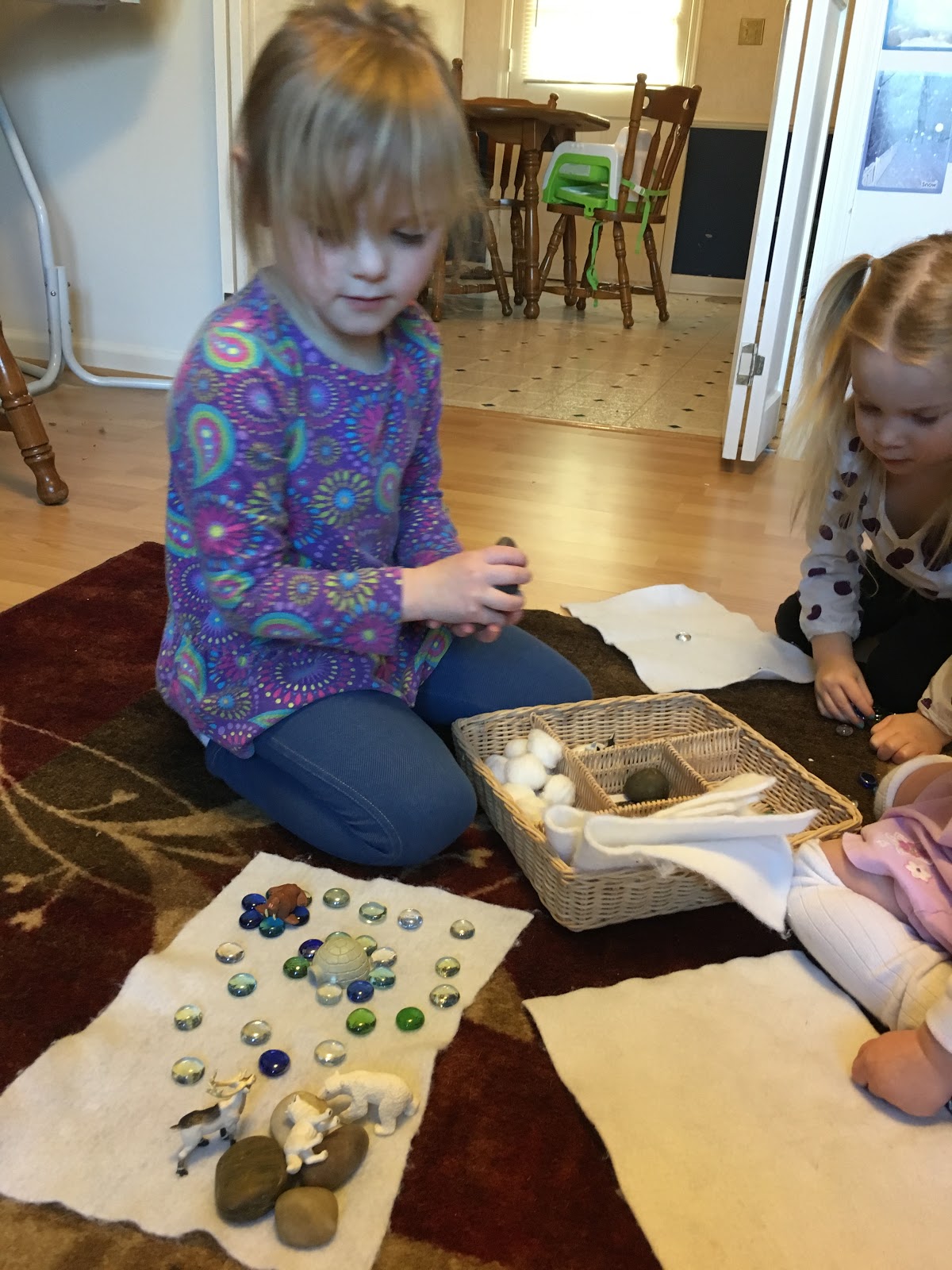
Polar Landscaping:  The children were invited to use loose parts such as stones, flattened marbles, cotton balls, felt, and Arctic animals to create these animal homes.


ART-
Black and white collage:  During Small Group, the students tore pieces of black paper while we discussed why animals that live at the poles often have black skin (even if its under white fur!) or feathers.  This color is best for absorbing heat from the Sun!  Polar animals also often have white fur or feathers for camouflage purposes.  Once the paper was torn, the school friends glued it onto white paper in collage fashion according to their personal preferences.


Pipette Icicles:  "What is an icicle?" Friend "K" asks.  That was a great question that we attempted to answer through an art experience.  Icicles are made when water melts, drips, and then refreezes.  We used pipettes at the easel with diluted grey and blue paint to see how liquid drips down.  More can be read on this activity here.


MATH-
Iceberg Number Recognition and Counting:  Ms. Harmony prepared these "icebergs" with numbers 1-10, star foil stickers, laminant, and blue painters tape.  First the children put the numbers in order.  If they weren't sure which number they had, they counted the stars to find out.  Then we tossed a beanbag on the icebergs.  Whichever number it landed on, the child hopped (like a penguin) to the iceberg and shouted out the number.


Snowflake geometry and shapes: This was one of our most recent awesome experiences!  The children learned about a new shape called HEXAGON that has six sides.  Snowflakes, although 100% unique, share a common trait of having six sides.  The school friends used large shapes to design their own "snowflakes" all over the rug during Circle Time.


We have really enjoyed the STEAM power through our studies of animals at the North and South poles!

Friday, January 25, 2019

Polar Process Art


Process art doesn't need to be super messy, or even very complicated.  The school friends folded, rolled, and twisted up foil, then painted with blue glitter (mixed with school glue), to create these FREEZY icicles!  Now to get them hanging up...


The art easel invitation this week included varying sized spools, and blue, white, and black paint.  This encouraged color mixing and exploration, along with size comparisons.


Finally, for Small Group, we worked our fine motor muscles by ripping up black paper.  We discussed why polar animals often have dark feathers or skin (even if it is covered by white fur) to stay warm.  Black is a color that absorbs heat.  Then we used glue bottles to squeeze out glue drops and arranged our torn paper in collage form on white paper.  Polar animals are often white to help blend into the snow and stay safe from predators.  Science, art, and small group discussion all in one activity... that's a win!

Thursday, January 24, 2019

Snow scenes, Mega-Block Giraffes, and Cookies


Making "small worlds" is one of Ms. Harmony's favorite ways to play!  The school friends used a tray of cotton balls, stones, gems, felt snow, and Arctic animals to create snowy scenes.  It was wonderful to see the children working together, naming animals, sorting, and quantifying materials.


 Friend "S" began building a tower with Mega-Blocks, but after using all of the pieces decided it looked like a giraffe!  That's the beauty of open-ended materials.  They can be turned into anything the child imagines.  :)


Toddler "K" and Friend "S" worked on making letter trains and sending them down ramps.  Friend "S" discovered that shorter trains race faster down the slide because they aren't as heavy.


The last plan of the morning was to make a Bakery.  Some friends "baked" the cookies, some "frosted" them, and lastly, some friends served the cookies up to the stuffed animals.  :)  There's just something about warm cookies on cold days that is super wonderful.


Tuesday, January 22, 2019

Snow What Fun!


Our first day of the 2019 Spring Session was super fun!  For Small Group, we put together a floor puzzle of polar animals.  Then we used magnifying glasses to notice which animals lived at the North Pole and South Pole.  Did you know that penguins only live in the southern hemisphere?  We used the floor puzzle, the wall map, and a globe to look at North and South poles, and to talk about the animals found there.

Some of the awesome dialogue about this activity included where the light was coming from when they used the magnifying glasses.  We noticed that wherever we moved the glass, a small spot of light followed.  The magnifying glass was catching the light from the room and shining it onto the puzzle.  We also observed that the magnifying glasses have a "small bump" that makes things look extra big!  These powers of observation really helped us notice where different animals live on the map.


Work Time was filled with creativity and fun as well!  Friend "S" used popsicle sticks and a paper towel tube together.  She poked holes in the tube with a pair of scissors.


Friend "B" and Toddler "K" connected a bunch of vehicle pop-blocks and measured each other.  When you connect all of the pop-blocks, it's the same height as friend "B!"


The Explore Table was full of South Pole discoveries!  The styrofoam packing peanuts are in the shape of the letter 'S' for "snow" and "south."  They make a great noise when you crunch them up, and are so much fun to toss and shower the penguins with snow!  The baby penguins are small enough to hide under the styrofoam too, so we had to sift through it all to find them.  The ping pong balls were "snowballs" or "eggs" depending on the plan.


Friend "S" worked at the Alone Table to connect Squigs to the mirror.  Friend "B" also did this plan and talked about it at Recall Time.  She mentioned that when they stick together they sound like"squish."  :D


There were so many other things that the school friends worked on while they were here!  Ms. Harmony will have to share those photos in a later post.  We don't want to overwhelm our readers with too much awesome-ness!

To finish up our day, we read a book about penguins and noticed that they had very short legs.  We tried out what it would be like to walk with super short legs by tying a bandanna around our ankles on going on a Penguin Parade.  :)  It was not a very fast way to get around.  We also pretended to sled on our bellies, hop, and swim like penguins to find a faster way to travel!


P.S.  Our sweet Baby Buddies had their own class downstairs and practiced taking naps and doing floor time.  :)  Baby "E" and Baby "E" are about one week apart.  How fun they get to play together while big sisters are learning and playing upstairs!


What's with the "Names?"

For new readers of the blog, this post is an explanation of the "names" Ms. Harmony uses when she writes about the school happe...

Read More!