Showing posts with label social problem solving. Show all posts

Tuesday, March 16, 2021

Spring Breathes Life to the World

After a long Winter sleep, Spring is officially just days away, and we are anticipating the seasonal changes that wake up the Earth.  When the Northern Hemisphere warms up, we expect to see plants bud and bloom.

Today we dissected old flowers from a bouquet.  As we took apart petals, stems, and leaves, we found interesting flower parts like where a flower keeps her eggs!  And, how the pollen is dusty, and sneaks down the tube to find the hiding eggs.  We also talked about different functions of the plant parts: petals are usually brightly colored to attract birds and insects to the nectar, stems hold up the flower and act like straws to suck water up to the top of the plant, and plants need to share pollen so the eggs can grow into more flower seeds.

We pretended to be "flower fairies" to help the garden grow.  Plants grow in order: roots down, shoots up, leaves, buds, and sometimes flowers and fruit.


We used toy butterflies to pretend to drink nectar from our flowers, and carry pollen around.  The flowers and leaves helped hide the butterfly eggs so we can "hatch more baby butterflies" (AKA- caterpillars).


Our Friend "Bride" decided to decorate the tree by adding flowers, and it was exciting to see Spring bring out her blossoms!


Outside, we continued to learn about Spring weather (even though today was very cold!).  The mountain snow will be melting and filling our rivers with fresh water.  We loved simulating a full spring brook with this flowing, specialized, water table.

When the bucket fills enough to tip, it makes a big wave that sends our boats over the waterfall and fills the next bucket.


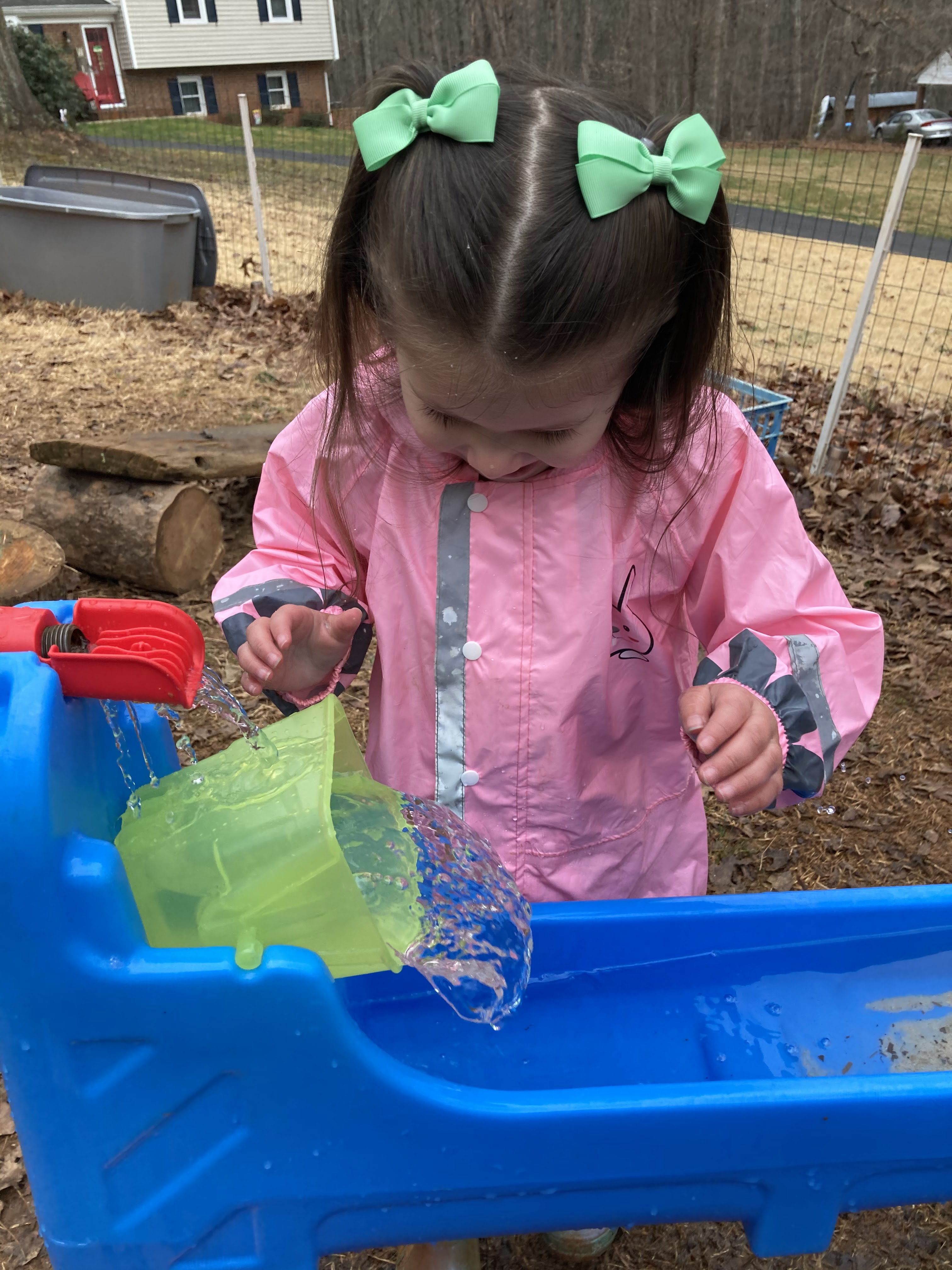
The anticipation of the bucket flipping is intense!  Well worth the wait, it's exciting to see the wave of water work in a cause and effect method.


And let's remember that air warmed by the Sun doesn't just sit around, it moves!  Spring can be a very windy time as warm air rises high and cool air whooshes low.  What better way to play with wind than by chasing bubbles in a breeze?


Welcome Spring and all the fun, interesting, and colorful aspects you bring to the world!  We might be young at Harmony's House, but we notice you Spring.  In fact, we are learning all about Spring with our whole bodies and all of our senses.  Life just couldn't be more exciting!

Tuesday, June 30, 2020

School is Back with Some New Friends!


We kicked off our summer session last week, and it has been so exciting to have new friends to play with!  We played the "Friends and Neighbors" game where we examined different scenarios of friends in need, and decided how to help them.  This game was helpful in guiding our conversation to different emotions, and why the character felt sad, or frustrated, or hurt.


We played another game where we matched our friends' names with their letter links.  This helped us practice saying our friends' names, but also helped us to listen to the way the names sound... especially the beginning sound of the name.


But most of all, we practiced BEING a friend by playing with friends!  This is our 'S' for Summer explore table!  (Everything in here starts with the 's' sound: sand, sea shells, suns, stars, sandals, sun glasses, stamps, and spoons.)


Friend "Alarm Clock" collected all of the sun rings.  She showed her friends how to put them on her fingers, and helped her friends do the same.  It was pretty tricky for some of our younger friends to slip those suns on each finger without dropping any!


But it was also cool to have a handful of sunshine too!  One of the best things about playing with friends is that they introduce new ideas and new ways to play.  :)

Tuesday, February 11, 2020

Everything is Awesome!


Friend "Sandwich" and Friend "Kite" have LOVED rocking out in the House Area!  For awhile, Friend "Sandwich's" theme song seemed to be "Everything is Awesome" from the Lego Movie.  ;-) He talked about attending a rock concert for several days before Ms. Harmony added microphones and guitars to the dress-up rack.

Friend "Kite" is an excellent back up vocalist and dancer.


The dance moves have been... AWESOME!  It is super fun to see the friends perform together and change roles.  One thing is for sure, when you come to Harmony's House, you WON'T be bored!


Let's give them a round of applause!

Thursday, September 12, 2019

Toddler Aggression: The Reasons and the Responses


Toddlers are super cute, but they can be super hurtful as well!  There are several reasons that toddlers behave aggressively, and being a sociopath is typically not one of them!  ;)  Take a breath... when your small child hits, they are very much like most toddlers out there.

Although feelings are always okay, certain actions are not because they are hurtful.  As teachers, caregivers, and parents, we need to respond to our toddler aggressors in a way that helps them develop prosocial skills.  To do this, we need to determine the function (the why) of the behavior.  Depending on the child's motive in the situation, our response to the child must differ.

Below you will find different strategies for responding to aggressive behaviors according to the behavior's function.  Be prepared to use many strategies with the child.  Be ready for it to take a few months for the child to incorporate new replacement behaviors.  Be patient, with yourself and the child.

Attention Seeking

  • Young children figure out right away that hurtful actions get a lot of attention from grownups!  (We naturally want to prevent other children or ourselves from getting hurt right?)  Negative attention is still attention, and counts to the young attention seeker.
  • Strive for five: for every one criticism/correction/redirection you give, strive to find five positive things to also share with the child.  ("Yes!  Your hands are pinching play-doh!  That is a great choice.  You look like you are having fun.)  This does two things: the child feels capable of making good choices, being a nice friend, and that you care about him/her.  Additionally, it helps you maintain positive feelings toward the child and avoid the rut of, "Sigh.  Why do you ALWAYS hurt people?!"  Likely, the child does not ALWAYS engage in negative behaviors and pointing the positives out to the child helps you as the adult remember this too.  CONNECTION.
  • Respond to the victim first.  "Are you okay?  Let's get you... cleaned up, back on your feet, etc. Did you like what happened?  Let's tell your friend that..."
  • Respond to the aggressor second.  "You pushed... (enter hurtful behavior) your friend.  You were upset... (enter applicable emotional label) and didn't know what to do."  
  • Be sympathetic so the child is able to hear your message.  If you are angry the child will be defensive or possibly afraid.  The brain will not be able to incorporate the next part of the exchange as readily due to that stress.
  • Continue: "You MAY NOT hurt your friend.  That is NOT okay.  You may do... (this or that) instead.  Let's practice that now."

Sensory or Motor Seeking

  • The growing child's body craves movement and challenges!  This is one way both hemispheres of the brain learn to communicate and synchronize.  We want children to learn about their bodies, the environment, and how to interact with the people and the world.
  • Hitting, kicking, and throwing are developmental milestones that we expect young children to meet, and they will typically practice these behaviors until they achieve mastery.  In certain circumstances, it is very appropriate to hit, throw, poke, pinch, or kick.  
  • Redirect hitting/kicking/throwing/pinching behaviors from peers to play-doh, instruments, pillows, beanbags, balls, and/or toys where it is okay to hammer.  
  • Redirect biting to chewable jewelry.

Undeveloped Social/Emotional Understanding

  • Because children this age are so young, they haven't yet learned to distinguish the idea that people and animals are different from objects because they have feelings.  They haven't learned perspective-taking yet, and so they are unaware that they might be hurting a friend and that friend has different feelings about what is happening than the instigator does.  This lack of social/emotional development (which is totally NORMAL for this age!) can lead to treating friends as objects.
  • This behavior might look like spontaneous, unprovoked injuring of another person.  Small children find that peers respond consistently to pain with howls, crying, etc. in the same way that maracas respond to shaking, piano keys respond to hitting, and pegs respond to hammering.  The aggressor is enjoying the consistency or sound of the response because they don't understand that what they are doing hurts.  People are not instruments or toys, and people have feelings.
  • To teach social emotional awareness, try this: "Look at your friend's face.  That's sad (hurt, angry, etc.- label the feeling)  They didn't like that.  To help our friend feel better, we need to apologize.  Say, 'I'm sorry I hurt you.  I will use soft hands next time.'"
  • Outside of the conflict, intentionally plan opportunities to teach social emotional awareness: 
    • sing "If You're Happy and You Know It" with different emotions.  Use dramatic facial expressions for each feeling and invite the children to do the same.  Explain what caused the feeling: "I am sad because biting hurts!  I hurt so I cry!"
    • read books and point out the faces and feelings of the characters, explain the cause and effect of those feelings in the plot
    • play with the mirror- children like making faces in the mirror, use this as an opportunity to talk about feelings versus body parts and features
    • role play- pretend to be an animal or person, act and talk the way someone else would
    • connect with past experiences- "Remember when your friend hit you and you were really sad?  That's how Johnny feels right now."

Undeveloped Communication Skills

  • Toddlers have better RECEPTIVE language than EXPRESSIVE language.  This means that they understand what you say a lot more than what they can say themselves.  Let's face it, actions come out faster than words at this age.  Even if the small child knows what to say, s/he may forget to use words in the heat of the moment.  
  • Teach social and problem solving language.  Intervene when a child makes a grab for a toy in another's hands and prevent a potential fight.  Prompt the child to use words, "You want that toy.  Let's ask first before we take: 'Sally, can I have that cat?'  'Oh, Sally isn't done yet.  Sally tell her, 'You can have it when I'm done.'"
  • Teach and model the words for sharing (using the toy together at the same time), trading (exchanging a toy for the one you want), and waiting for a turn (eg. using a timer).  Resolving problems with these tools demonstrates respect for other's feelings and fosters positive feelings between friends.
  • Practice taking turns in speaking and listening.
  • Use consistent language with the child so they learn what your words/instructions mean: "Use soft touches" or "Your friends like nice hands..."
  • The younger the children, the simpler the language (both vocabulary and number of words)


Undeveloped Executive Functioning


  • Executive functioning skills are higher level brain functions.  They allow you to choose your response instead of responding with emotion.  They allow you to delay gratification.  They allow you to make plans, and review how they went.  They allow you to use logic amongst other things... and they are continuously developing in a person until s/he is a young adult.  Therefore, we cannot expect young children to cope with the environment and people in the same capacity as an adult.  But we CAN support the development of executive functioning skills within the child.
  • Be consistent with redirection and consequences.  For example, the child might need to lose privileges if s/he is repeatedly acting in hurtful ways.  A logical consequence is that the child must walk away from the activity where the hurtful behavior was occurring.  Perhaps the child requires the use of a time-out or calm-down place.  Remember that negative consequences cannot be the only response to replacing these behaviors with positive ones.  
  • It is critical to maintain a positive relationship with the aggressive child and be the child's "safe place" while providing consistent redirection and consequences.  When the child decides that s/he is "just a bad kid" or that the teacher "can't be pleased" then s/he will likely stop trying to improve.  Don't create a self-fulfilling prophecy for the child.
  • Maintain proximity to help the child in the heat of the moment make the best choice instead of waiting to clean up the aftermath.
  • Let age and maturity work magic on your efforts.  It will happen for each child at a different time in a different way.  Every day, every minute, YOU get to help build this child's brain.


Saturday, August 17, 2019

Music, Meals, and Monsters


The instruments have been a huge hit with the new class.  One starts playing, Ms. Harmony starts singing, and soon everyone is sitting around playing keys, shaking maracas, or tapping a tune!

The "popcorn piano" is especially popular.  When you push the keys, in addition to playing a sound, the "popcorn" pops up inside the instrument!  Friend "Sandwich" patiently waited for his turn at the Alone Table to play it.


For young preschoolers and toddlers, joining/working a collaborative plan is developmentally challenging!  This week we worked more with this objective by:

  • asking to join a friend by saying, "Can I play too?"
  • inviting a friend to join by saying, "Do you want to play with me?"
  • Ms. Harmony modeled both through play via the Duplo Lego people and invited the children to "talk back" with a person

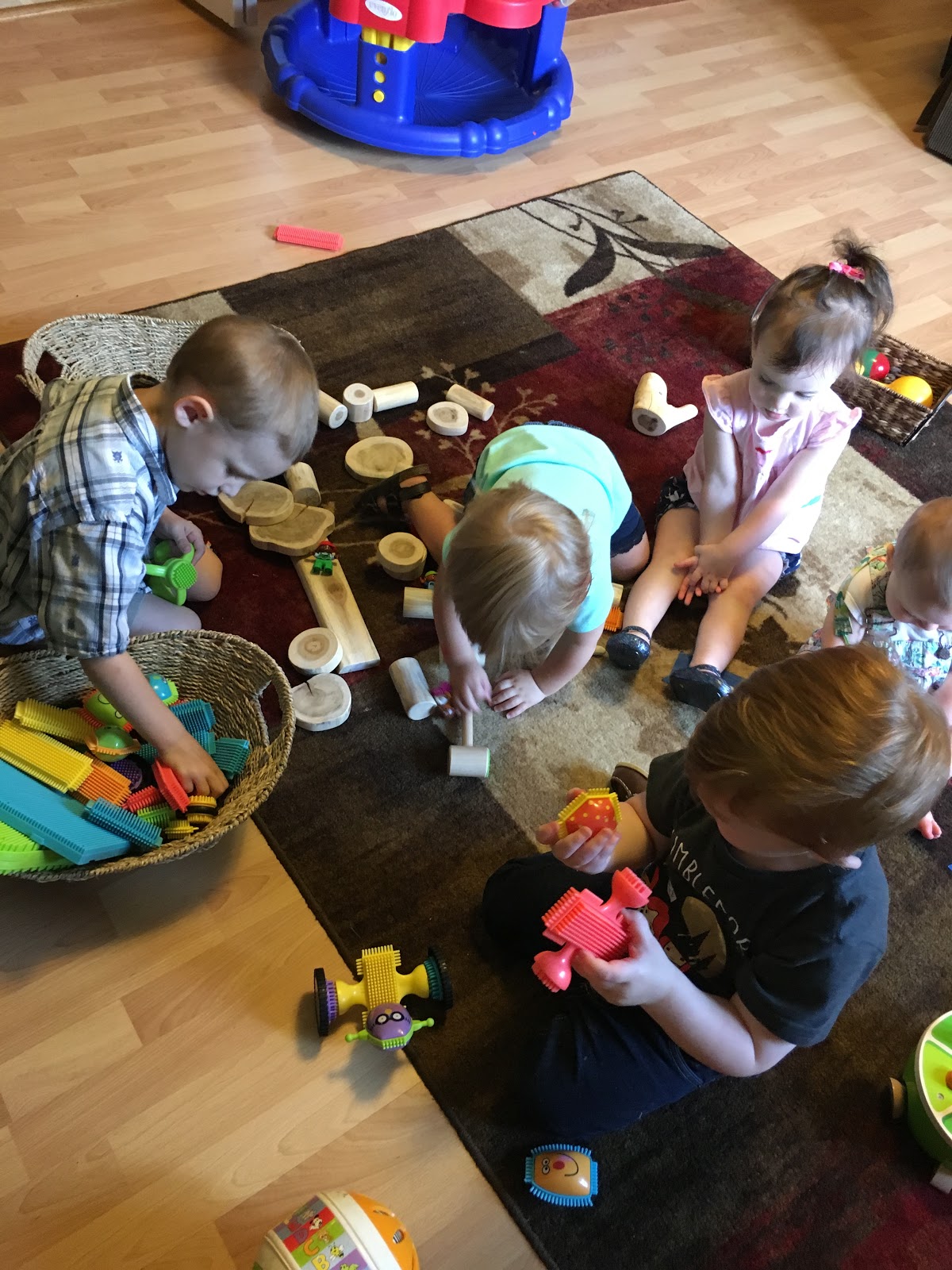
In the plan featured here, we used the log blocks to make a table, chairs, booster seats, etc. and helped all the Lego people sit down.  Friend "Sheep" suggested we serve cupcakes.  We realized we didn't have any cupcakes so we used a bristle block instead.  We helped our Lego people sing "Happy Birthday" and the school friends chimed in.  They helped their person "eat."


This was a great opportunity to practice playing together, and most of our friends contributed to the plan in a productive way by building, "talking" through a Lego person, or helping the Lego person to "eat."  Over the course of the year, Ms. Harmony will facilitate these spontaneous group plans less and less as the children do them independently more and more.


Including the Bristle Blocks into the plan prompted more building.  Friends "Sheep" and "Sandwich" both experimented with using the bristle blocks to make cars, cakes, and especially monsters!  Here's Friend "Sandwich's" Monster Man!


Friday, August 2, 2019

Let's Get Cookin'


We recently had a new kitchen addition come to our House Area, thanks to the awesome Tonkinson family!  The kids walked in and immediately said, "Wow!!  A new kitchen!  Thank you!"  They loved it, to put it simply.  ;)


We used our telephones to call in orders for food like pizza, hot chocolate, soup, and tea!  We even ordered for our pets!  We traded roles, added sick beds, served meals, and played restaurant.  The new kitchen was a great springboard for imaginative, cooperative, role play.  :)

Friday, February 8, 2019

Drinks Anyone? More Fun with Circles!


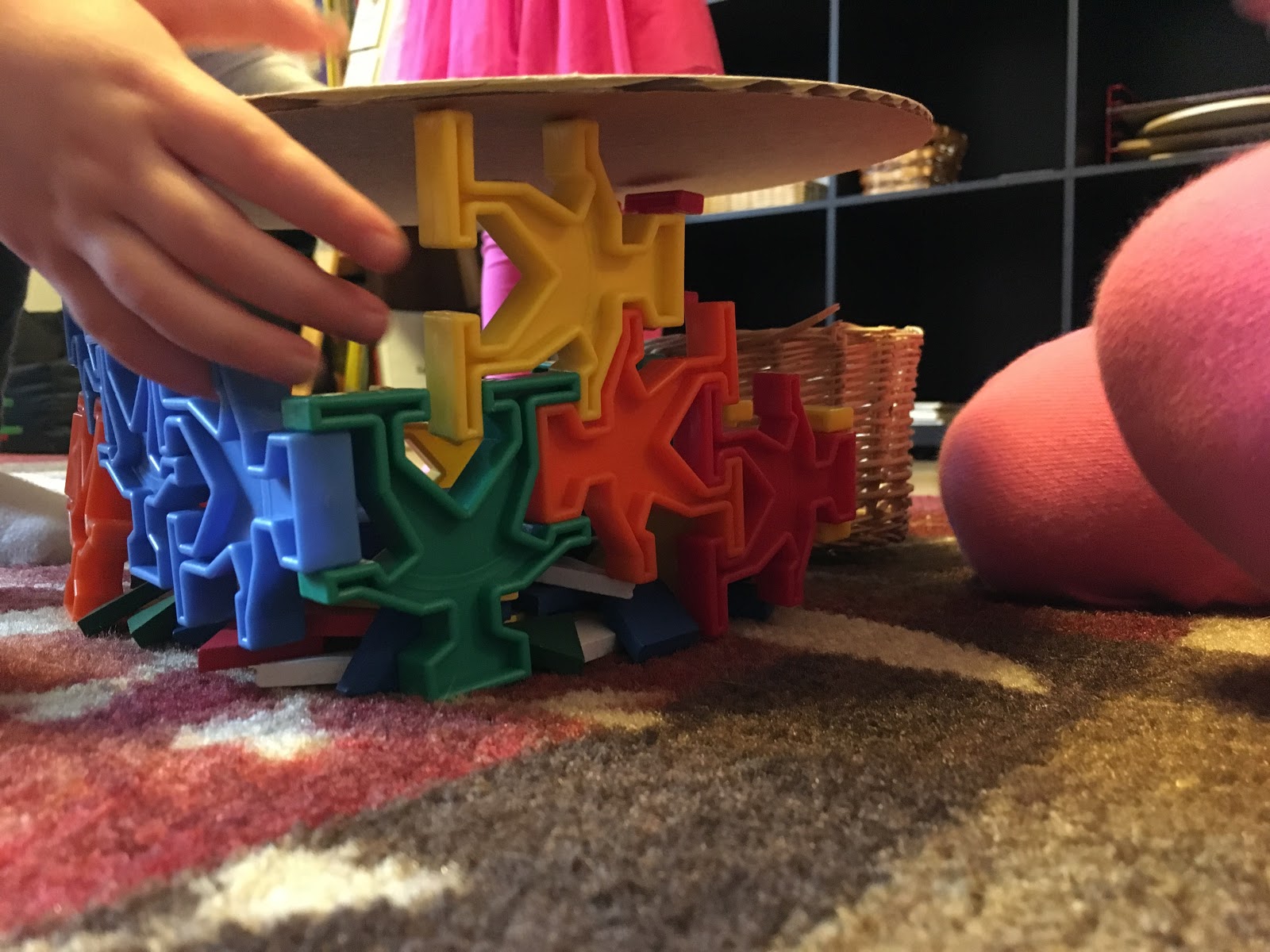
Yesterday we shared a post about the school friends using these "circles" (spools, cups, and cake rounds) to make penguin houses and ice fortresses.  Today the circles were used as carrying trays for our drinks!  The school friends mixed up different kinds of "juice" with shapes and gems, and carried them around serving drinks.  Super tasty!


Friend "K" made herself a throne on the sofa and ordered drinks!  If they were not to her liking she sent them back!

The circles made a great roof for this Robot House also!  But then it became a cake platter for the million-layer rainbow cake!


Fantastic imaginations and socio-dramatic play.  :D  Excellent work school friends!

Tuesday, September 18, 2018

It's Been a Hard Day's... Morning

...And we've been working like dogs!  :P

We have been mixing colors in the Art Area to create Fall hues with our new roller brushes.


We've been making play doh creations with cut straws, fuzzy sticks, and googly eyes.  Some of the creations ended up being monsters or porcupines.  :)


Our House Area fun has included using the new microphones and blow-up guitars.  Sometimes we make up our own words, and sometimes we sing songs that we know.  Baby "K" likes everyone to wear sunglasses in the band.


Lastly, here are some photos of the Toy and Puzzle Area plans of late.  Friend "K" likes to open these letter acorns.  Inside are small toys that begin with the same letter and sound printed on the outside of the acorn.  She dumps them all out, then matches the uppercase and lowercase letters (acorn with cap), and finds the corresponding small toy to put inside.


We have enjoyed many puppet shows depicting friendship themes such as sharing toys, taking turns, helping a friend in need, checking on a hurt friend, and telling jokes.  :)


The school friends have been creative using the Lego Duplos, fabric scraps, and baby counters to make cribs and play spaces for the babies.  Baby "K" is learning to work next to her friends without climbing on their work or taking their plans.  The school friends have learned to tell Baby "K," "This is my work.  You can have these... (blocks, pieces, babies, etc.)"


It is always a good day at Harmony's House when you see the school friends learning and growing in play skills, socialization, and cognitive abilities.  Great work friends!  You make your teacher's heart happy!  :)

What's with the "Names?"

For new readers of the blog, this post is an explanation of the "names" Ms. Harmony uses when she writes about the school happe...

Read More!