Showing posts with label rocks. Show all posts

Monday, July 27, 2020

A-MUSE-ing Rocks


During July, we built on a student interest: rocks!  Each child at Harmony's House has a rock collection at home, so we brought that interest alive in the classroom as well.  One small group activity was to use magnifying glasses to study an assortment of rocks.


We talked about things that we noticed and recorded our observations for parents to appreciate.  Some of our rocks were geodes, cooling slowly after having lots of heat and pressure.  This made crystals form.  Some of our rocks were full of bubbles (holes), made by volcanoes.


Other rock samples were magnetic, and we found one other rock besides hematite that was also magnetic.  We found rocks that were flat (sandstone), rough (desert rose and scoria), and smooth (apache tears and agate).


Some of our rocks were special because they were fossils!  Fossils are rocks that are remnants of something that was once alive such as a plant or animal.  We know about dinosaurs because of fossils!  So we naturally played with dinosaurs too.


Our Explore Table was filled with kinetic sand, rocks, dinosaurs, and aquarium plants.  The wonderful thing about the kinetic sand was that it would show us how dinosaurs made tracks that could be preserved.  We could also pretend that a dinosaur was hatching from an egg.  Finally, we could bury a dinosaur and see how the body left prints behind.  Remnants of bones, eggs, tracks, and even dinosaur poop helps us learn about how dinosaurs lived long ago.


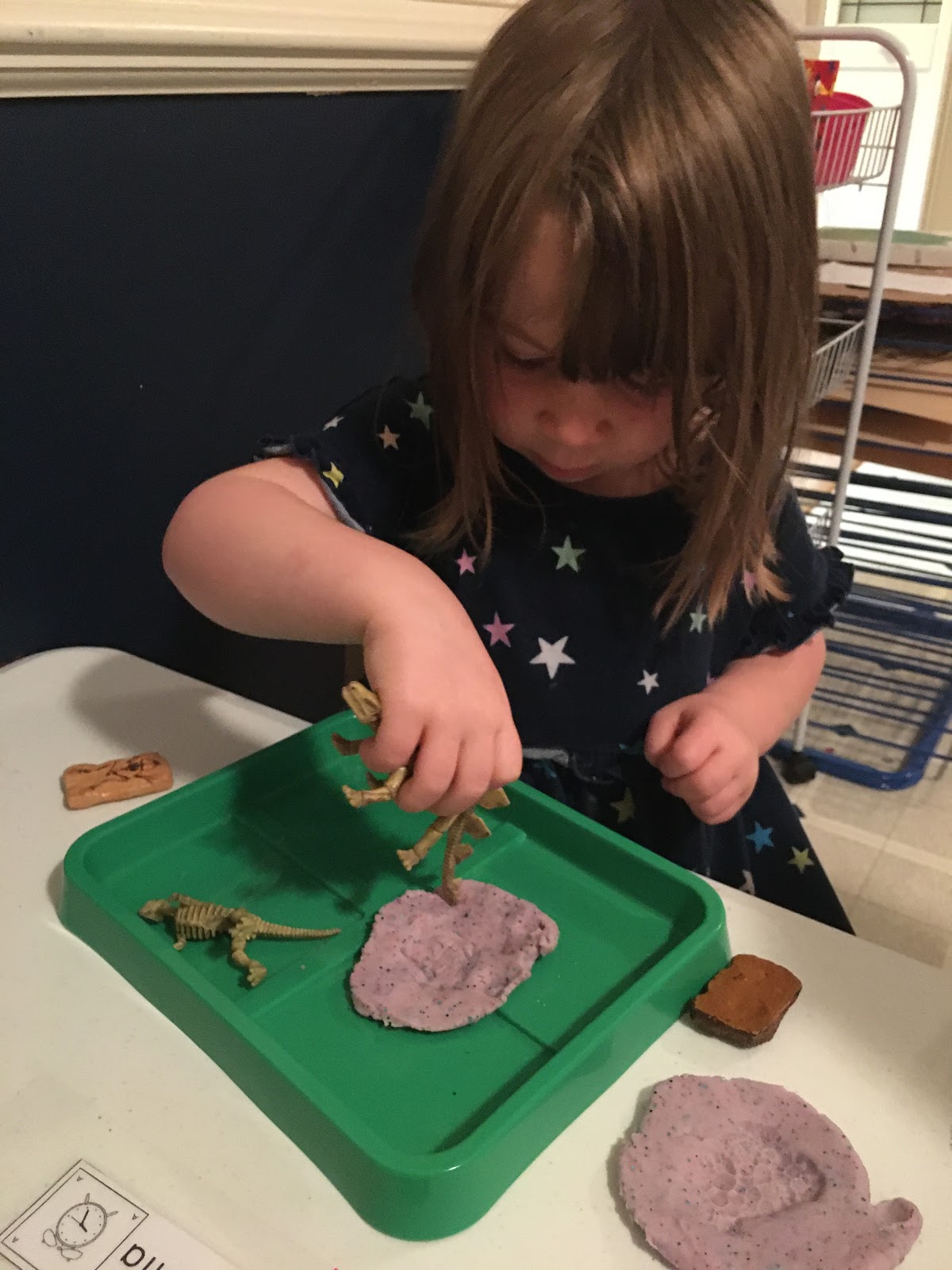
In the Art Area, we used toy dinosaur skeletons to again talk about fossils... but we also used them to see whether the dinosaur walked on two legs or four.  The prints turned out great!


No childhood can be considered complete without rocks and dinosaurs.  What a fun unit this has been for our miniature geologists!

Thursday, April 30, 2020

Emergent Curriculum Creeping Out of the Grass


Last week we found an Eastern Box Turtle on the playground!  It was super exciting and interesting!  We have started building a unit around turtles to build on this spark of interest.


The day we found him, we talked about how to hold him safely.  Any animal that has a mouth could bite, so use two hands and keep them away from his mouth.  He eats food like leaves and berries, meal worms, and buggies.

(We know he is a male because he has red eyes, bright orange spots on his arms, and a slight indentation on his bottom shell which helps him stay balanced when mounting his mate.)


We talked about how his shell was hard like finger nails.  When he feels scared, he can tuck is head, legs, and tail into the top and bottom parts of the shell to keep them safe.  We noticed his toenails that help him dig.  We observed that this was an animal with bones, dry scaly skin, and no hair.  He does have eyes, mouth, and nose like us.


We read Mossy by Jan Brett later in the day.  This beautifully illustrated book of fiction helps reinforce the idea that wild animals are happiest in their own habitat.  Eastern box turtle populations in this area have been declining due to poaching for pets, getting crushed under cars or lawn mowers, and deforesting the turtle habitat.  We released our box turtle after we handled him just like Mossy was returned to her natural home in the book.


Since we could not keep the wild turtle that we found, we further explored turtle habitats and what turtles need to live in the Block Area with turtle toys, stones, and silk plants.


We created several turtle homes complete with vegetation, pools of water, rock climbing mountains and more!


Seeing the children's interest and knowledge increase through stories and play following a real-life experience has been turtle-ifically awesome!

Monday, October 7, 2019

Finding Fall?


The forest animals are going to start getting ready for winter soon!  One of the best ways to spot forest animals is by going camping.  We made a cool tent in the Book Area, stocked up on flashlights, and made animal dens.  So cool!


We hid animals around the room and used binoculars or flashlights to find them.  Bears make sure to eat lots of food during the summer and fall to prepare for winter.


Deer are busy eating too.  Food is hard to find in the winter.


Friend "Sandwich" asked, "Which pinecone is the spikiest?"  Great question!  He and Toddler "Koala" tested them out and then used them to make some animal dens.


Flashlights are also great for helping you find your belly button... in case yours is missing.  ;)


Wednesday, May 1, 2019

Play-doh Plates (the Tectonic Kind!)


This week we dug deeper into the idea of Our Earth, kind of literally.  First we used a book to see illustrations of the Earth and interior layers.  We learned new vocabulary like "crust," "tectonic plates," and "magma" (melted rocks that the tectonic plates float on).

Next we used play-doh to form tectonic plates and discover three ways the Earth makes mountains.


1.  Fold mountains- a real world example of tectonic collision is the Himalayan mountains, and these types of mountains are identifiable by their jagged peaks

2.  Volcanic eruptions- when a tectonic plate moves over a hot spot and magma pushes up onto the land, we call it a volcanic eruption (like the Hawaiian islands)

3.  Dome mountains- sometimes the magma pushes up but does not find an outlet, and it cools forming a rounded mountain


Lastly, we observed how when tectonic plates fold, collide, go under one another (subduction), the Earth makes layers.  When lots of heavy mountains are on top, and really hot magma is underneath, the layers in the middle are changed through pressure and heat.  This is how we get different kinds of rocks.  In summary, geology rocks!  Especially when reenacted with play-doh.  ;)

What's with the "Names?"

For new readers of the blog, this post is an explanation of the "names" Ms. Harmony uses when she writes about the school happe...

Read More!